

Building Trust in the Age of Autonomous Service Robots: Why Safety is the Foundation of Adoption


Executive Summary
The acceleration of autonomous and service robot adoption across workplaces, healthcare, hospitality, and public environments is transforming the modern service economy. Yet as robots move closer to people, safety, trust, and governance have emerged as the defining success factors for large-scale deployment.
This article outlines the global landscape of robot safety standards—from ISO 13482 and ISO/TS 15066 to UL 3300 and the NIST AI Risk Management Framework—and introduces GlobalDWS’s Service Robot Safety & Risk Assessment Blueprint, a practical framework that enables organizations to implement safe, compliant, and human-centric automation programs.
Drawing from over 13 years of GlobalDWS experience delivering cognitive automation and smart-workplace solutions, this article explains how a rigorous approach to safety transforms robotics from a technological innovation into a sustainable enterprise capability.
Market Overview & Key Statistics
Robotics is entering its most pivotal adoption phase since the industrial automation revolution.
Global Growth: Over 205,000 professional service robots were sold globally in 2023—a 30 % year-over-year increase, led by transport, hospitality, and cleaning robots.
Sustained Momentum: 2024 preliminary figures indicate approximately 200,000 units sold (+9 % YoY).
Hospitality Segment: The U.S. hospitality service-robot market reached US $ 1.26 billion in 2024, projected to grow to US $ 3.25 billion by 2032 (≈ 12.7 % CAGR).
Workplace Efficiency: Autonomous Mobile Robots (AMRs) in logistics have doubled throughput rates while improving worker safety and engagement.
Human Acceptance: In healthcare and hospitality, structured training and clear safety policies significantly increase employee and guest trust.
Regulatory Convergence: The EU Machinery Regulation (2023/1230) and EU AI Act (2024/1689) introduce mandatory lifecycle-risk and AI-safety provisions by 2026–2027.
These figures confirm a global inflection point: robot adoption is accelerating, but sustained success depends on the maturity of safety frameworks and the ability to manage human–machine collaboration responsibly.
1 The Expanding Frontier of Human–Robot Collaboration
Service robots now share space with people in offices, senior-living centres, hospitals, and campuses. This new proximity challenges traditional safety concepts that once relied on physical separation.
International standards such as ISO 13482 (Personal-Care Robots) and ISO/TS 15066 (Collaborative Robots) establish the foundation: robots must be designed for inherently safe operation, with limits on speed, force, and contact, and supported by structured risk assessment and validation.
These standards emphasize a key principle—shared spaces demand shared responsibility. Manufacturers, integrators, and operators must collectively ensure that human–robot collaboration enhances rather than endangers human wellbeing.
2 From Standards to Practice: The GlobalDWS Safety & Risk Framework
Recognizing the complexity of multi-environment deployments, GlobalDWS has developed a Service Robot Safety and Risk Assessment Framework—a blueprint aligning with ISO 12100, 13482, 15066, UL 3300, and the NIST AI RMF 1.0.
Our model integrates seven pillars of enterprise assurance:
Governance & Accountability – Establish a cross-functional Robot Safety Committee covering EHS, IT/OT, Privacy, and Operations.
Comprehensive Risk Assessment – Evaluate physical, cognitive, and data-related hazards using ISO 12100 methodology.
Functional Safety & Controls – Implement speed, separation, braking, and force-limiting mechanisms verified to required performance levels.
Cybersecurity & Privacy – Apply zero-trust architectures, encryption, and privacy-by-design principles (PIPEDA-aligned).
Training & Competency – Certify operators and staff through structured education on safe interaction and emergency response.
Change Management & Lifecycle Monitoring – Re-assess risks following software updates, route changes, or payload modifications.
Continuous Improvement & Transparency – Track incidents per 1,000 operating hours and publish performance metrics for accountability.
This framework enables organizations to move from compliance to confidence, ensuring every deployed robot operates within validated safety boundaries.
3 Safety by Design: Engineering and Human Factors
Our experience across smart workplaces, long-term-care facilities, and public venues confirms that safety depends on more than sensors and code. It must extend to ergonomics, accessibility, and user psychology—the human-factors dimensions addressed within global safety standards.
GlobalDWS embeds these considerations through:
Collaborative Workspace Modelling – mapping human–robot zones with 3D LiDAR and digital-twin simulation.
Speed & Separation Monitoring (SSM) – dynamic velocity adjustment based on real-time human detection.
Power & Force Limiting (PFL) – biomechanically informed thresholds reducing impact risk in contact scenarios.
Accessible Design – AODA-compliant navigation, visual/audio cues, and inclusive interaction interfaces.
The result is a human-centric robotics environment that enhances productivity while maintaining comfort and trust.

4 AI Risk and the New Safety Dimension
Modern service robots increasingly rely on AI for perception, navigation, and decision-making. This autonomy introduces a new safety layer: algorithmic accountability.
Drawing from the NIST AI Risk Management Framework and ISO/IEC 23894, GlobalDWS extends traditional risk assessment to include:
Bias and explainability in AI models
Resilience to adversarial inputs and sensor spoofing
Secure data governance for video and voice streams
Transparent AI lifecycle documentation for regulatory readiness
In doing so, we ensure that AI-driven autonomy remains interpretable, auditable, and ethically aligned—a necessity as new regulations such as the EU AI Act and Canada’s AIDA framework emerge.
5 Beyond Compliance: Safety as a Catalyst for Innovation
Enterprises often perceive safety as a constraint; in reality, it is the catalyst for scalable innovation. Organizations that embed safety frameworks from the outset experience:
Faster regulatory approvals and pilot authorizations
Higher user acceptance and employee engagement
Improved ROI through reduced downtime and incident costs
Brand differentiation as trusted AI innovators
At GlobalDWS, we view robot safety as an enabler of digital transformation—turning risk management into a platform for continuous improvement and responsible automation.
6 Technical Safety Controls
Safety begins at the hardware and software level. Technical controls ensure predictable performance in dynamic environments:
Navigation & Speed Management: Configurable speed zones and safe-stop distances to prevent collisions and tipping.
Detection & Avoidance Systems: Multi-sensor fusion (LiDAR, depth cameras, ultrasonic) for obstacle detection and path planning.
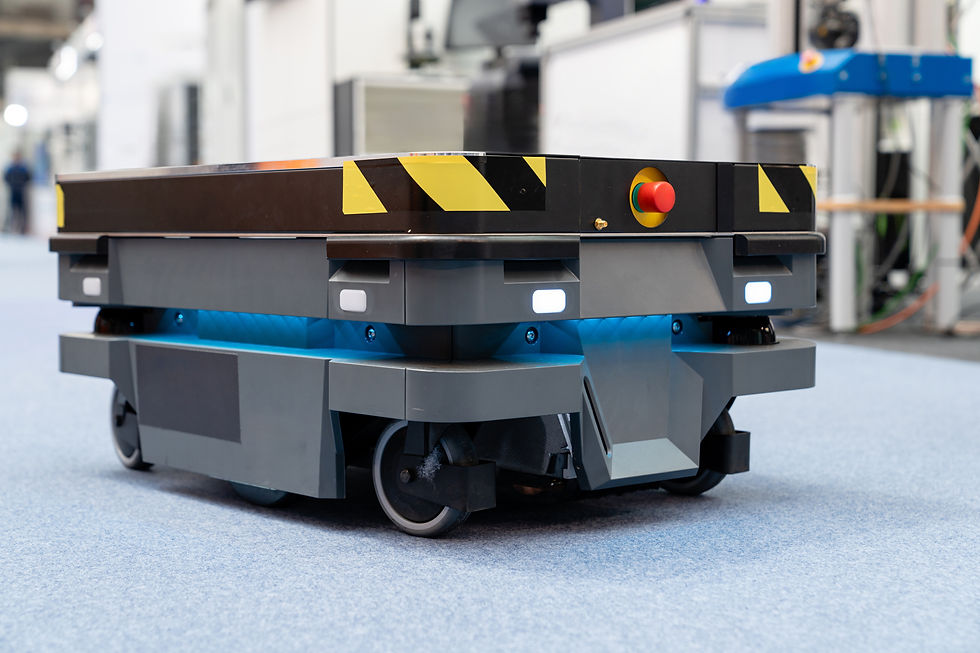
Emergency Stop & Manual Override: Accessible E-stops, fail-safe braking, and fault-tolerant recovery logic.
Battery & Charging Safety: Certified battery packs, automated docking interlocks, and fire-response procedures.
Functional Safety Validation: Verification of SSM, PFL, and performance levels before commissioning.
7 Operational Best Practices
Operational governance translates design safety into daily practice:
Route Governance: Geo-fenced maps, exclusion zones, and time-of-day operating rules.
Role-Based Training: Certified training for operators, security, and facilities staff with periodic refreshers.
Maintenance & Inspection: Pre-use checklists, incident logs, and quarterly safety audits.
Incident Management: Defined escalation pathways, telemetry preservation, and corrective/preventive actions.
Continuous Monitoring: Dashboards tracking mission completion, near-misses, and mean-time-between-failures (MTBF).
8 Privacy & Cybersecurity
With AI and connectivity at the core of service robots, privacy and digital security are essential dimensions of physical safety:
Privacy-by-Design: Data minimization, transparent signage, and retention limits for any collected data.
Network Security: VLAN segmentation, zero-trust architecture, and encrypted communications.
Access Control: Role-based authentication, credential rotation, and secure API management.
Resilience & Response: Continuous vulnerability scans, incident runbooks, and supplier patch-management reviews.
This integrated approach protects not just the robot—but the organization’s brand, users, and digital ecosystem.
9 Market Evidence & Business Impact
Safety is both a compliance requirement and a business differentiator. Enterprises leading in safety governance achieve measurable outcomes:
Reduced Downtime: Up to 40 % fewer interruptions through predictive maintenance and validated safety logic.
Faster ROI: Shorter pilot-to-production cycles enabled by early compliance alignment.
Improved Workforce Morale: Higher employee trust and engagement where robots operate transparently and safely.
Customer Confidence: Public perception shifts from novelty to reliability, accelerating adoption.

10 Environmental & ESG Contributions
Safe robotics deployment aligns directly with Environmental, Social, and Governance (ESG) principles:
Environmental: Energy-efficient navigation, automated shutdowns, and sustainable materials reduce carbon footprint.
Social: Robots enhance inclusivity by assisting the elderly, supporting accessibility, and minimizing ergonomic strain.
Governance: Documented safety and privacy frameworks fulfill transparency expectations of investors and regulators.
By embedding ESG metrics into robotics programs, organizations transform automation into a responsible innovation platform that supports global sustainability goals.

11 Our Call to the Industry
As adoption accelerates, the robotics community faces a defining moment. We must harmonize safety, ethics, and performance to earn society’s trust.
GlobalDWS invites industry partners, regulators, and research institutions to collaborate in advancing open frameworks, certification pathways, and workforce training that make safe automation universal.
Together, we can ensure that robots not only work for us—but with us—safely, intelligently, and responsibly.
About GlobalDWS
GlobalDWS is a Canadian innovation leader in smart-workplace automation, combining Robotics, AI, IoT, and Digital Twins to enable the Future of Work. With over 13 years of experience deploying robots across healthcare, hospitality, education, and enterprise environments, GlobalDWS has developed a comprehensive Service Robot Safety and Risk Assessment Blueprint to help organizations adopt autonomous systems securely and ethically.
Learn more at www.GlobalDWS.com
References & External Links
Primary Standards & Frameworks
ISO 13482 (2014) – Robots and Robotic Devices: Safety Requirements for Personal Care Robots
ISO/TS 15066 (2016) – Collaborative Robots
ISO 12100 (2010) – Safety of Machinery – Risk Assessment and Risk Reduction
UL 3300 (2024) – Service, Communication, Information, Education & Entertainment Robots
NIST AI Risk Management Framework (2023)
ISO/IEC 23894 (2023) – Artificial Intelligence – Guidance on Risk Management


Comments